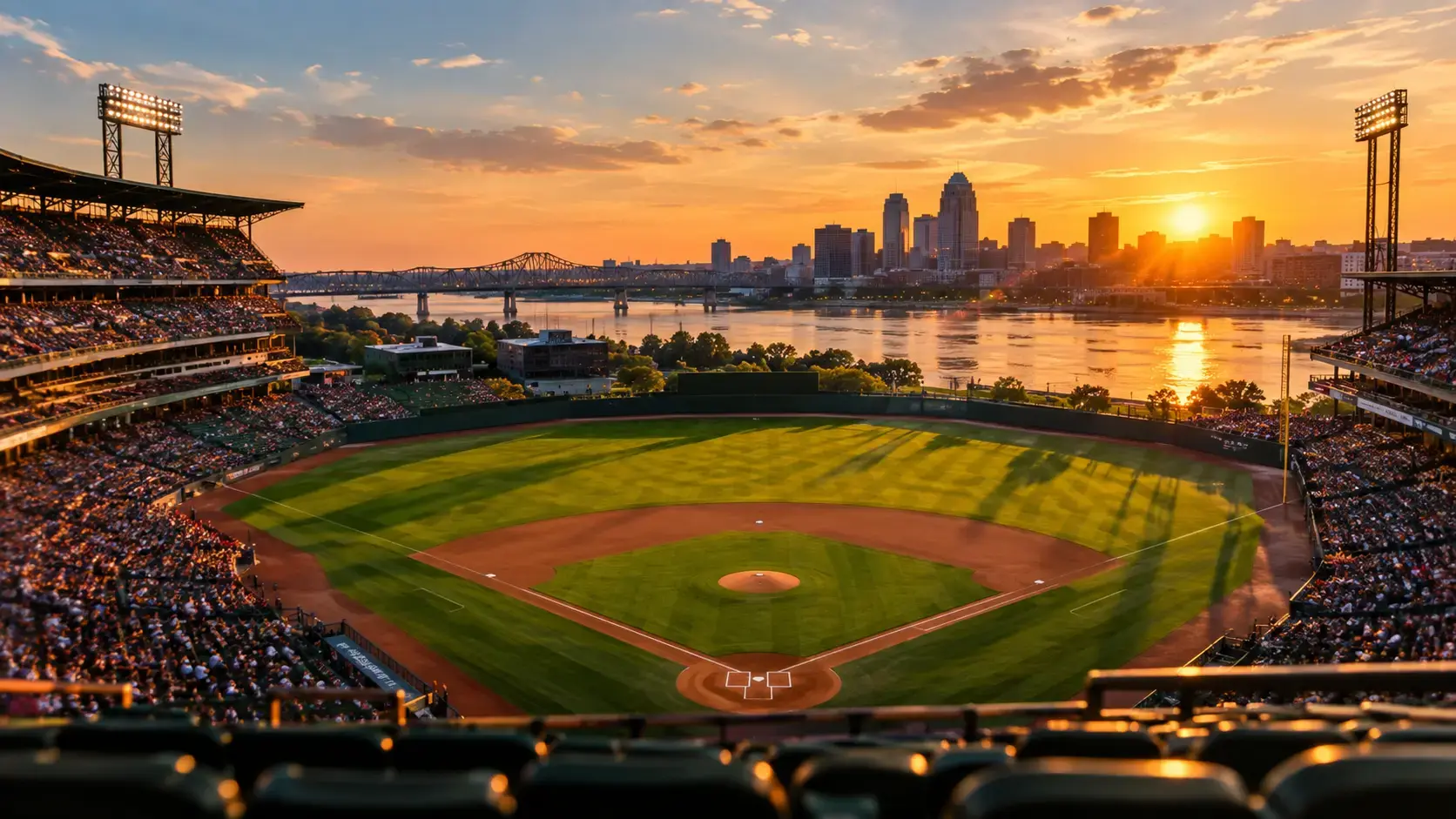
A Cincinnati Reds game typically runs about 2 hours and 38 minutes of playing time, reflecting the league-wide average since MLB introduced the pitch clock in 2023. Counting gates, which open 90 minutes before most first pitches, and the post-game wind-down, plan for roughly 4 to 4.5 hours total at Great American Ball Park for an evening game.
Compare live ticket listings for every remaining home date on the Cincinnati Reds Tickets hub page.
If you're planning your day around a trip to Great American Ball Park - parking, dinner on The Banks, or catching the last train home - here's exactly what the timeline looks like, from gates opening through the final out.
As one of the oldest franchises in Major League Baseball, tracing its roots back to 1869, the Reds have played baseball in Cincinnati for well over 150 years, and while the game itself has changed dramatically since the Big Red Machine era of the 1970s, the basic structure of nine innings, a seventh-inning stretch, and extra innings when necessary remains the backbone of every home date at Great American Ball Park.
What Time Do Gates Open at Great American Ball Park?
Gates at Great American Ball Park typically open 90 minutes before first pitch for weekend games, though some weekday games have opened gates as little as 60 minutes before first pitch, depending on that day's specific promotional schedule and opponent.
Because exact gate times can shift slightly by date - especially around giveaway nights, batting practice viewing, or Friday fireworks games - checking your specific game's listed gate time before you head downtown is worth doing rather than assuming a flat 90-minute rule applies to every single date on the schedule.
How Long Is a Regulation Baseball Game?
A regulation MLB game consists of nine innings, with each team batting until three outs are recorded, and the away team batting first in each inning (the "top") followed by the home team (the "bottom").
Unlike sports with a fixed running clock, baseball has no set time limit - the game simply continues until nine full innings are completed, or until the home team is ahead after the visiting team bats in the ninth.
League-wide, the average nine-inning MLB game in the 2025 season ran about 2 hours and 38 minutes, a meaningful drop from the roughly 3-hour-plus average that was common before 2023.
Because both teams play the same number of outs regardless of how many runs are scored, a lopsided blowout doesn't necessarily run shorter than a close, well-pitched game - pacing depends far more on pitching changes, pace of play, and how many batters reach base.
Why Have MLB Games Gotten Shorter Since 2023?
MLB introduced a pitch clock in 2023 - giving pitchers a set number of seconds to begin their delivery between pitches - along with limits on defensive shifts and pickoff attempts, all aimed at speeding up pace of play. The result was one of the most significant single-season drops in average game length in modern MLB history.
Before the pitch clock, games had crept up toward and past the 3-hour mark on average, driven by longer gaps between pitches, more mound visits, and extended replay reviews. The rule changes trimmed roughly 20 to 30 minutes off the average nine-inning game almost immediately, and that shorter pace has held steady in the seasons since.
The pitch clock gives pitchers 15 seconds to begin their windup with the bases empty and 20 seconds with runners on base, while batters must be in the box and ready with at least 8 seconds remaining on the clock.
Violations result in an automatic ball for the pitcher or an automatic strike for the batter, which has proven to be a strong enough deterrent that clock violations have become relatively rare as players adjusted to the new pace across the 2023 and 2024 seasons.
How Long Is the 7th Inning Stretch?
The 7th inning stretch is a brief pause between the top and bottom of the seventh inning, typically lasting just a few minutes, during which fans traditionally stand and sing "Take Me Out to the Ball Game." It's not a formal timed break the way halftime is in other sports, but rather a customary pause built into the natural inning transition.
What Happens in Extra Innings?
If a Reds game is tied after nine innings during the regular season, it moves to extra innings, and starting with the 10th inning, each team begins its turn at bat with a runner placed on second base - a rule MLB made permanent for regular-season games starting in 2023 specifically to shorten extra-inning games and reduce bullpen strain across a long season.
This runner-on-second rule, sometimes informally called the "zombie runner" or "ghost runner" rule, means extra-inning games during the regular season tend to resolve faster than they did in past decades, since both teams start each extra frame with a real scoring opportunity already in place.
Games can still theoretically continue indefinitely if both teams keep scoring and matching each other, but the rule has meaningfully reduced the number of marathon extra-inning affairs compared to the pre-2023 era.
Extra innings remain one of the more unpredictable parts of any baseball game's total runtime. While a typical extra frame with the runner-on-second rule tends to wrap up faster than a traditional extra inning, particularly aggressive or conservative managerial strategy - intentional walks to set up a double play, for instance, or a team playing for a single run rather than a big inning - can still stretch a tied game out longer than fans might expect, even with the shortened format in place.
Does Game Length Change in the Postseason?
Yes - the extra-innings runner-on-second rule used in the regular season does not apply in the postseason, meaning a tied playoff game continues under traditional rules with no runner placed on base, which can result in significantly longer games than a regular-season contest that reaches extra innings.
This distinction matters if you're comparing a regular-season Reds game to a potential postseason appearance: postseason extra-inning games have historically run dramatically longer than their regular-season counterparts precisely because that pace-of-play safety net isn't in place once October baseball begins.
Do Doubleheaders Change the Schedule?
Yes - modern MLB doubleheaders are almost always "straight" doubleheaders featuring two full nine-inning games (rather than the seven-inning doubleheader format MLB used temporarily from 2020-2022), typically separated by a break of 30 to 50 minutes between games rather than requiring a full second admission.
If you're attending a doubleheader specifically, budget for a significantly longer day at the ballpark - two full nine-inning games plus a break between them can easily add up to 5 to 6 hours or more, depending on how both individual games play out.
Doubleheaders typically happen when a previously rained-out game needs to be made up, and MLB schedules generally try to slot these into an existing off day or combine them with an already-scheduled game against the same opponent, meaning true doubleheaders have become relatively uncommon on a full 162-game slate compared to earlier eras of the sport when scheduled doubleheaders were far more routine.
A Brief History of Great American Ball Park
Great American Ball Park opened on March 31, 2003, replacing Cinergy Field (formerly known as Riverfront Stadium), which had served as the Reds' home from 1970 through 2002.
The new ballpark cost roughly $290 million to build and sits directly on the Ohio River in downtown Cincinnati, with two decorative smokestacks in right-center field paying homage to the steamboats that historically traveled the river.
The ballpark's official capacity has hovered around 42,000 to 43,500 seats since opening, spread across three seating levels. It's widely known among players and fans as a hitter-friendly park, with relatively short outfield dimensions - 325 feet down the right field line and 328 feet down the left field line - that make it one of the easier parks in MLB to hit a home run in, a factor that can occasionally influence how long a high-scoring game runs compared to a pitchers' duel.
Does Weather Affect Game Length?
Yes - rain delays are called at the umpiring crew's discretion whenever field conditions become unsafe or unplayable, and a delay can range from a brief 15-to-20-minute pause to a multi-hour wait, or in rare cases, a full postponement and reschedule if conditions don't improve.
Cincinnati's spring and summer weather can bring sudden thunderstorms, so if you're attending a game during a period of unstable forecasts, it's worth checking the team's official channels on game day for any weather-related updates before you head to the ballpark.
Games that are official (meaning at least five innings have been completed, or four and a half if the home team is ahead) are typically allowed to end early due to weather rather than being fully replayed, which can occasionally make for a shorter-than-average night at the ballpark.
How Does Great American Ball Park Compare to Other MLB Parks for Pace?
Game length itself is driven far more by MLB's league-wide pitch clock rules than by any single ballpark's characteristics, meaning a Reds game at Great American Ball Park runs on essentially the same average pace as a game at any other MLB stadium under the same rules.
Where ballparks genuinely differ is in pre-game and post-game logistics - how far parking is from the gates, how quickly the surrounding area clears out, and how easy it is to get in and out of downtown.
Great American Ball Park's riverfront downtown location means postgame traffic can take a while to clear, particularly after a sellout crowd, even though the game itself won't run any longer or shorter than the same matchup would elsewhere in the league.
Full Game Day Timeline
Here's roughly what to expect for a 6:40 p.m. weeknight first pitch:
| Time | What's Happening |
|---|---|
| 5:10-5:40 PM | Gates open (60-90 min before first pitch, check your specific date) |
| 6:40 PM | First pitch |
| 8:00 PM | Roughly the midpoint of a typical 2h 38m game |
| 9:15-9:20 PM | Final out (based on the 2025 league-average game length) |
| 9:20-9:45 PM | Fans exit, postgame traffic and parking lot wind-down |
Most fans can expect to be leaving Great American Ball Park by roughly 9:30-9:45 p.m. for a 6:40 p.m. first pitch, longer if the game goes to extra innings or includes an unusually high number of pitching changes.
What Time Should You Arrive?
• Arrive close to the gate-open time listed for your specific game - don't assume a flat 90-minute rule applies to every date, since some weekday games open later.
• Plan extra time for parking downtown, especially on weekend games or during a homestand against a popular opponent.
• If you want to watch batting practice, arriving right at gates-open is your best bet, since BP typically wraps well before first pitch.
• Factor in a longer night if you're attending a game with fireworks or a postgame concert, both of which extend your total time at the ballpark beyond the final out.
• Check the forecast before heading downtown during unstable spring or summer weather, since a rain delay can add anywhere from 15 minutes to several hours to your night.
• If you're attending a doubleheader, plan for a significantly longer day - pack accordingly and expect to be at the ballpark for 5 hours or more.
Final Thoughts
Between gates opening roughly 90 minutes early and a game that now averages under 2 hours and 40 minutes thanks to the pitch clock era, plan for a full afternoon or evening of roughly 4 to 4.5 hours at Great American Ball Park - longer for extra innings or a doubleheader. Knowing the rough timeline ahead of time makes it easier to plan parking, dinner on The Banks, or your ride home.
Ready to catch a game live? Compare current listings on the Cincinnati Reds tickets page.
Frequently Asked Questions
How long does a Cincinnati Reds game last?
A game typically runs about 2 hours and 38 minutes of playing time, based on the 2025 MLB league average, with total time at the ballpark closer to 4 to 4.5 hours once you count gates opening 90 minutes before first pitch.
What time do gates open at Great American Ball Park?
Gates typically open 90 minutes before first pitch for weekend games, though some weekday games have opened as little as 60 minutes before first pitch - check your specific date.
Why did MLB games get shorter recently?
MLB introduced a pitch clock and other pace-of-play rules in 2023, cutting the league-wide average game length by roughly 20 to 30 minutes compared to pre-2023 seasons.
What happens if a Reds game is tied after 9 innings?
During the regular season, extra innings begin with a runner placed on second base for each team starting in the 10th inning, a rule designed to shorten extra-inning games. This rule does not apply in the postseason.
How long is a doubleheader?
Modern MLB doubleheaders feature two full nine-inning games separated by a short break, meaning a doubleheader can easily run 5 to 6 hours or more in total.
When did Great American Ball Park open?
Great American Ball Park opened on March 31, 2003, replacing the Reds' previous home, Cinergy Field (formerly Riverfront Stadium).
Does rain affect how long a Reds game takes?
Yes - rain delays can range from a brief pause to several hours, or in rare cases a full postponement, depending on field conditions and the umpiring crew's judgment.
Is Great American Ball Park considered a hitter-friendly park?
Yes - its relatively short outfield dimensions, particularly down the foul lines, make it one of the easier MLB parks to hit home runs in.